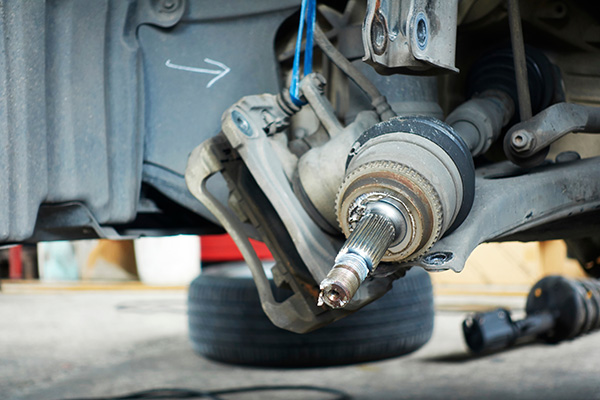
CV axles transfer power from the transmission or differential to the drive wheels while allowing the suspension to move and the wheels to steer. Each axle uses constant velocity joints that can operate through changing angles without interrupting power delivery.
A CV axle can remain in service for many years, but torn boots, lost grease, contamination, impact damage, and normal wear eventually affect the joints. Early symptoms often begin with clicking, vibration, or grease around the inside of a wheel. Addressing these signs promptly can prevent a worn joint from failing and leaving the vehicle unable to move.
1. Clicking While Turning
A repeated clicking or popping sound during a tight turn is one of the most recognizable signs of outer CV joint wear. The sound is usually strongest while accelerating through a parking lot turn, making a U-turn, or backing out with the steering wheel turned sharply.
Outer CV joints operate through their greatest angle when the wheels are turned. If the internal grooves, bearings, or cage are worn, the joint can no longer transfer torque quietly through that angle. The clicking often becomes faster as vehicle speed increases.
A worn outer joint commonly makes more noise when turning in one direction, but sound can travel through the body and make the affected side difficult to identify from the driver’s seat. A road test and physical inspection are needed before replacing an axle.
2. Grease Around The Wheel Or Suspension
CV joints are packed with specialized grease and sealed by flexible rubber or thermoplastic boots. The boot expands and contracts as the suspension and steering move. If it splits, cracks, or pulls away from a clamp, grease can escape while dirt and water enter the joint.
Escaping grease is often thrown outward by axle rotation. It may appear on the inside of the wheel, brake components, strut, control arm, or surrounding splash shields. A narrow line of grease around these areas often points directly toward a damaged boot.
Common boot concerns include:
- Cracks between the folds
- A loose or missing clamp
- Grease around the large boot opening
- A split near the smaller axle-shaft end
- Damage caused by road debris
- Boot distortion from incorrect installation
A torn boot does not always mean the joint has already failed. If the damage is found early, the joint remains quiet, and contamination has not entered, boot replacement may be possible on some vehicles. Once clicking or looseness develops, replacing the complete axle assembly is usually the better repair.
3. Vibration During Acceleration
An inner CV joint can create vibration or shuddering when torque is applied. The symptom may be strongest while accelerating from a stop, climbing a hill, or applying moderate throttle at highway speed. It may decrease when the accelerator is released.
Inner joints must change length slightly as the suspension moves while continuing to transfer power. Wear in the joint tracks can cause the axle to move unevenly under load. Bent axle shafts, incorrect replacement axles, or excessive joint clearance can create similar vibration.
Tire imbalance usually produces vibration that follows road speed whether the vehicle is accelerating or coasting. An inner joint concern tends to react more directly to engine load. Engine mounts, transmission mounts, wheel bearings, and driveshaft components should also be checked because they can produce related symptoms.
4. Clunking During Direction Changes
A worn CV joint may clunk when shifting between Drive and Reverse or when moving from acceleration to deceleration. The sound comes from excessive clearance being taken up as torque changes direction through the axle.
The clunk may also be felt through the floor or steering wheel. If wear becomes severe, the vehicle can produce repeated knocking during low-speed movement rather than one isolated sound.
Several components can create a similar clunk, including:
- Engine and transmission mounts
- Loose suspension bushings
- Worn differential components
- Driveshaft joints
- Transmission engagement faults
- Loose axle nuts or hub splines
Technicians inspect the complete drivetrain rather than identifying a CV axle from the sound alone. Axle play, mount movement, wheel bearing condition, and transmission engagement all need to be evaluated under controlled conditions.
5. Steering Changes Or A Vehicle That Will Not Move
Severe CV joint wear can affect steering feel, especially when an outer joint binds during turns. The steering may feel uneven, produce vibration, or resist returning normally after a corner. A damaged axle can also create scraping or knocking as it moves through different suspension angles.
If the joint breaks completely or the axle pulls apart, engine speed may rise while the vehicle remains stationary. On many open-differential systems, power follows the failed side instead of reaching the wheel with an intact axle. The vehicle may lose forward and reverse movement even though only one axle has failed.
A broken axle can also damage nearby parts. The loose shaft may strike brake hoses, wiring, suspension components, the transmission case, or the wheel well. A vehicle with severe clunking, binding, or sudden loss of drive should be stopped and towed.
How Technicians Check A CV Axle
The testing process begins with a road test to determine whether the symptom occurs during turning, acceleration, coasting, braking, or gear changes. The vehicle is then raised so the boots, clamps, axle shafts, splines, and surrounding components can be inspected.
Technicians check for grease leakage, looseness, binding, impact damage, and abnormal movement. They also inspect wheel bearings, mounts, suspension parts, and axle seals. Diagnostic testing may be needed when vibration or clunking could come from the transmission or another drivetrain component.
Regular maintenance should include an inspection of CV boots before they split completely. Finding a small crack early may prevent grease loss and extend the life of the joint.
Get CV Axle And CV Joint Repair In Northridge, CA, With RM Automotive
RM Automotive in Northridge, CA, can inspect CV boots, inner and outer joints, axle shafts, wheel bearings, mounts, and related drivetrain components.
Contact us to schedule service if your vehicle clicks during turns, vibrates under acceleration, leaks grease, or clunks when changing direction.